

3 Simple Signs to Check Your
Baby's Head Shape at Home
Discovering an uneven head shape can bring up a lot of questions. The good news is that an infant’s skull is incredibly responsive to gentle, natural guidance when monitored early.
You can perform a quick, stress-free assessment at home during a calm moment—like right after bath time when your baby's hair is damp and flat. Look for these three key visual signs:
The Bird’s-Eye View (Top-Down Check)
Look directly down at the top of your baby’s head from above. Imagine the head shape as a geometric outline.
What to look for: A symmetric head should look like a smooth, even oval. If you notice a flat spot on one side of the back of the head that makes the overall shape look more like a skewed parallelogram, this is a common sign of Plagiocephaly. If the back looks uniformly wide and flat, it may be Brachycephaly.

What to look for: Are the ears perfectly parallel, or is one ear pushed slightly further forward than the other? When a flat spot develops on one side of the skull, it gently misaligns the surrounding areas, often shifting the ear on that same side forward.
While still looking down from the bird's-eye view, draw an imaginary horizontal line across your baby's head, connecting one ear to the other.
The Ear Alignment Test

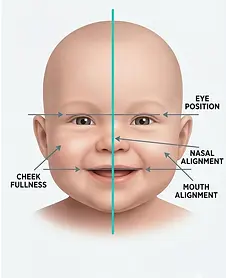
The Facial Symmetry Check
Turn your baby around so they are facing you directly at eye level. Look closely at the symmetry of their forehead, cheeks, and eyes.
What to look for: Look to see if one cheek appears slightly plumper or fuller than the other, or if one side of the forehead seems to gently protrude or "boss" forward. Because the skull plates are interconnected, flattening at the back can create a subtle diagonal push that lightly affects facial alignment at the front.
The Three Main Deformities

Plagiocephaly
(The Asymmetrical Flat Head)
-
What it looks like: Flattening on one side of the back of the head. From above, the head looks like a parallelogram. One ear or cheek may appear pushed forward.
-
Why it happens: Usually caused by a preferred sleeping position, or a tight neck muscle (Torticollis) that makes the baby favor turning their head to one side.
-
How a helmet helps: The custom helmet acts as a gentle pathway, preventing the flat spot from pressing further against flat surfaces while leaving room for the flat area to naturally grow out and round out.
Brachycephaly
(The Wide Flat Head)
-
What it looks like: The entire back of the head is uniformly flat, making the head look unusually wide from the side and causing the forehead to sometimes look prominent or elevated.
-
Why it happens: Often seen in babies who sleep exceptionally well flat on their backs or spend prolonged periods on firm surfaces like crib mattresses or strollers.
-
How a helmet helps: It gently redirects skull growth from the sides back into the flattened rear area, establishing a beautiful, balanced, natural head proportion.


Scaphocephaly
(The Long & Narrow Head)
-
What it looks like: The entire back of the head is uniformly flat, making the head look unusually wide from the side and causing the forehead to sometimes look prominent or elevated.
-
Why it happens: Often seen in babies who sleep exceptionally well flat on their backs or spend prolonged periods on firm surfaces like crib mattresses or strollers.
-
How a helmet helps: It gently redirects skull growth from the sides back into the flattened rear area, establishing a beautiful, balanced, natural head proportion.